Klara and the Father Destroy the Original Cootings Machine
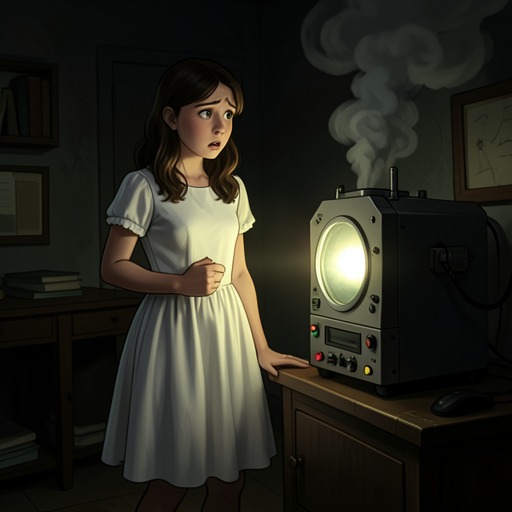
Klara and the SunKlara and the Father Destroy the Original Cootings Machine is an act of resistance against a machine whose smoke had obscured the Sun and weakened Klara. Klara helps Paul identify the target and exploit its vulnerability; afterward, Paul confirms that the machine has been disabled. But the later appearance of a distinct New Cootings Machine reveals the limits of their success: the original is destroyed, while the pollution-producing system continues.
Causes and Background
Klara first observes the Cootings Machine from the store, where she has been moved from the window to the magazines-table side. Its arrival is preceded by days of disruptive preparation: overhaul men mark off part of the street with wooden barriers, then drill and break up the pavement. The taxi drivers protest with their horns, and the drilling frightens the AFs in the window. Klara initially wonders whether the machine might fight pollution; Rex tells her instead that it is designed to produce more.
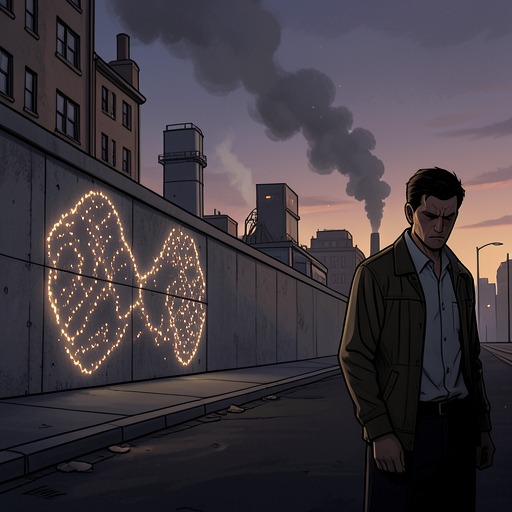
The machine’s operation makes the threat visible. Three short funnels send up smoke that changes from white puffs into a single dark cloud. As the smoke thickens, it divides Klara’s view of the street into panels, hides the gap of sky, and leaves dirty dots on the store window. The Sun’s patterns disappear from the floor, alcoves, and walls. Though the patterns briefly return faintly on the second bad afternoon, after four continuous days of pollution Klara feels herself weakening; during empty stretches in the store, her posture sags until Rex touches her arm to remind her to stand straight.
Planning the Destruction
Later, Klara tells Paul that the old store was not the true reason she asked him to drive into the district. They had passed a pollution-producing machine nearby, and she insists that it must be destroyed. She identifies it by its name, Cootings, and by its three funnels. The mission arises from her conviction that stopping the machine matters to Josie, although the evidence does not establish that Josie knows about Klara’s agreement with the Sun.
Paul explains how the machine might be disabled. It contains a middle-market Sylvester broad generation unit, built to withstand dust, smoke, and rain, but vulnerable to a substance with high acrylamide content. He names P-E-G Nine solution as an example: introduced into the system, it would rapidly polymerize and likely cause terminal damage. This technical explanation gives Klara and Paul a specific means of attack rather than merely a target.
Destruction and Apparent Success
The evidence of the destruction comes through its aftermath. As the group travels past a later machine, Klara recalls Paul at the yard saying that he heard the little fizzing sound and that the monster would not rise again. The sound serves as his confirmation that the original machine has been disabled. Klara also remembers Paul checking her immediately afterward, asking whether she was all right and how many fingers she could see, a gesture that links the operation’s mechanical risk to concern for her physical condition.
Klara later acknowledges that she and Paul made a sacrifice in trying to stop the pollution, and that Paul acted with faith in her hope despite knowing nothing of her agreement with the Sun. Her account frames the act as a joint effort: Klara supplies the purpose and the appeal to the Sun, while Paul helps her carry out the attempt. The evidence does not describe the precise mechanics of the destruction, so the fizzing sound and Paul’s assurance remain the clearest reported signs that it succeeded.
The New Machine and the Limits of Victory
The apparent success does not end the pollution. During a later car journey, Klara sees another machine behind overhaul men’s barriers, pumping smoke from three funnels. Its yellow body is a different shade and somewhat larger than the one destroyed in the yard; Klara recognizes that its capacity to produce pollution is at least equal to the first machine’s. The discovery overturns her assumption that destroying the original had stopped the threat.
Klara interprets the second machine as a failure in her task. In her appeal to the Sun, she admits that she had not considered the possibility that another machine could keep the pollution going without a pause. She asks that the Sun recognize how hard she tried and accept that Josie is innocent of the bargain and unaware of it. The episode therefore has two distinct outcomes: the original Cootings Machine is put out of action, but the continuing appearance of pollution leaves Klara fearing that the Sun’s promised special nourishment for Josie may not come.
Significance
The destruction turns pollution from a distant public concern into an immediate bodily and relational danger. At the store, the smoke darkens the day, obscures sunlight, and weakens Klara; the harm is gradual rather than concentrated in a single spectacular accident. The machine’s barriers, street works, and continued operation also show how an imposed environmental cost can persist in ordinary urban space while those exposed to it have little ability to make it stop.
The episode’s structure sharpens the difference between defeating one object and changing the conditions that produced it. Paul’s confirmation that the original machine will not rise again offers a moment of relief, but the later sight of its larger successor revises that confidence. For Klara, the failure is not simply technical: she treats the pollution as a test of her promise to the Sun and fears that her inability to prevent its return may affect Josie. The action thus becomes both a concrete attempt to disable a polluter and a limited victory whose consequences remain unresolved.